Art in Alternative Spaces
Art in Alternative Spaces
presents
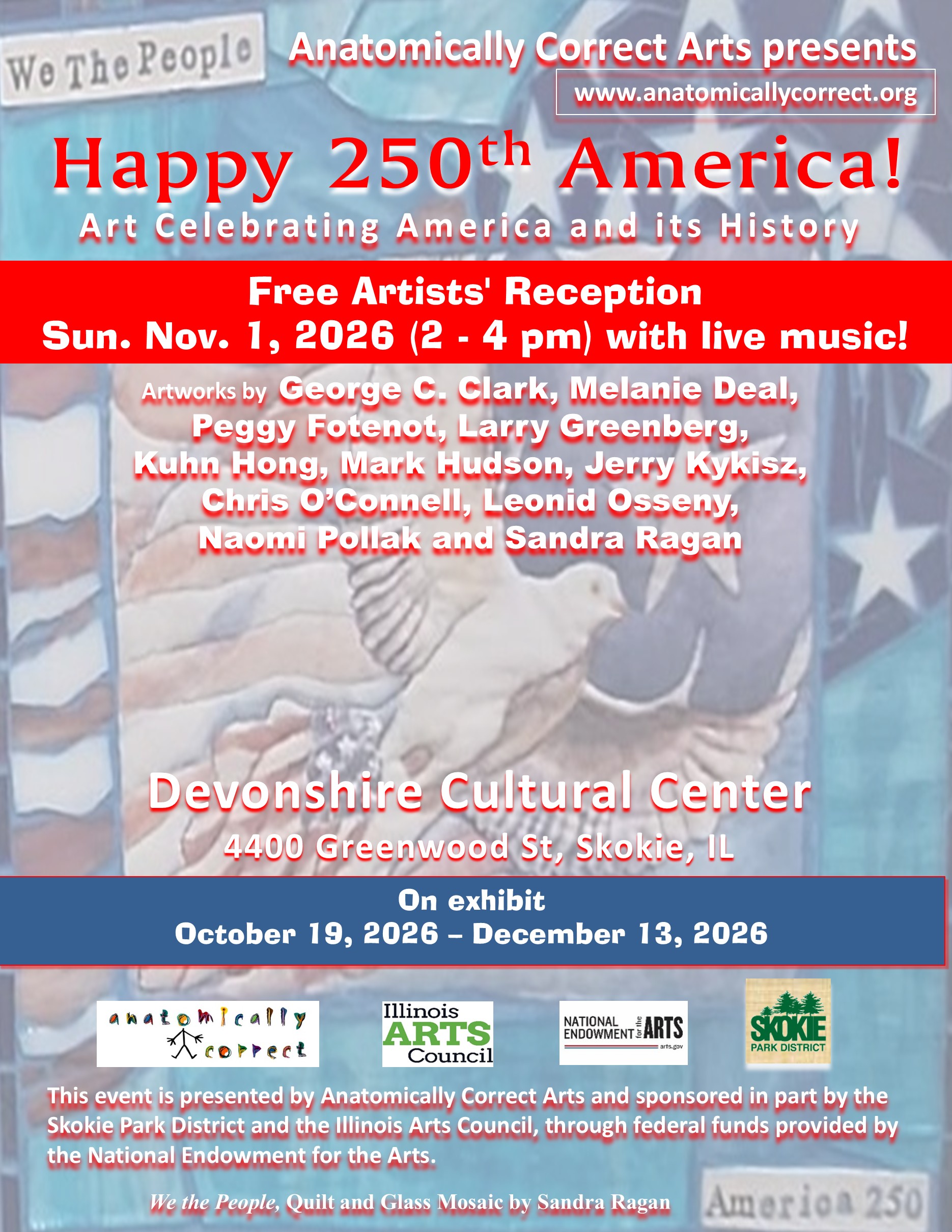
We the People:
Happy 250th America!
Celebrating America and its History
Artworks by George C. Clark, Melanie Deal,
Peggy Fontenot, Larry Greenberg,
Kuhn Hong, Mark Hudson, Jerry Kykisz,
Chris O'Connell, Leonid Osseny,
Naomi Pollak and Sandra Ragan
On Exhibition
at Devonshire Cultural Arts Center
4400 Greenwood St, Skokie, IL 60076
Free Artists Reception
Sun. Nov. 1, 2026 (2 - 4 pm)
On Display
October 19, 2026 - December 13, 2026
The building is handicap accessible.
Admission to the exhibition is FREE.
Gallery Viewing Hours are:
Mon - Thurs: 9 a.m. – 5 p.m.
Fri, Sa, Su: 9 a.m. – 4 p.m.
Closed Holidays
FREE PARKING!
TO PURCHASE ARTWORK, EMAIL INFO@ANATOMICALLYCORRECT.ORG
GEORGE C. CLARK
George’s love of the railroad, trains, and their history inspired him to create a series titled “The Age of Iron”. The Iron Age is important in celebrating America’s 250th birthday, when iron became an important material for building tools, machinery, and railroads, helping the country grow and develop. As the United States expanded during the 1800s, the railroad system became one of the most important parts of American history, connecting cities, towns, farms, and industries across the country. Trains made it easier to transport people and goods over long distances and helped shape the nation’s economy and communities. The completion of the Transcontinental Railroad in 1869 marked a major milestone by connecting the eastern and western railroad networks. Over time, America’s love of trains grew through the development of powerful steam locomotives, elegant passenger trains, and massive freight trains. Today, trains continue to fascinate people because of their engineering, history, impressive size, and the excitement of watching them travel along the tracks. The Iron Age and the growth of the American railroad system together represent how metalworking, technology, and transportation helped transform the United States into a modern nation.
After graduating with honors from the School of the Art Institute of Chicago, George C. Clark began a long career in advertising and graphic design, interrupted by 13 months of combat as a draftee in Vietnam. He began a parallel career in fine arts with his first one-person gallery show in 1978. Since then, his landscapes, figure paintings, and graphics have been exhibited and won awards at many Midwestern museums and galleries in and around the Chicago area. His art can be found in the collections of the United States Air Force, the Illinois State Museums, the Kinsey Institute, the National Veterans Art Museum, the John H. Vanderpoel Art Museum, the Sheraton Station Square Hotel in Pittsburgh, the Quaker Oats Company in Chicago, McDonald’s Corporate Headquarters in Chicago, Sandoz/Novartis AG of Switzerland, Chicago State University Business School Hall of Fame, and many other corporate, institutional, and private collections located mostly in the Midwest but also in California, Texas, New York, Israel, Japan, and England. In 2017, he was a featured artist on Chicago’s PBS Station WTTW in an on-camera studio interview titled “Longtime Chicago Portrait Artist Focuses on the Face”. George has several online blogs covering such topics as Travel Art, Vietnam Art, and Railroad Art. This is Mr. Clark’s fourth exhibition with Anatomically Correct Arts.
Melanie Deal
Melanie’s celebration of US history comes from her memories as a child and her lifelong love of comic books, paper dolls, toys, TV, literature, and music. She remarks, “Cutting and pasting is just as fun and satisfying as it as an adult as when I was in kindergarten. I’m fascinated by grids, tessellations, and repeated images. I reinforce this repetition through colors and materials. Because patterns tend to be orderly and predictable, I like to add unexpected elements for humorous or ironic effect.” This is Melanie’s second exhibition with Anatomically Correct Arts.
Peggy Fontenot
Peggy Fontenot is an award-winning Native American photographer. Although she humbly considers herself self-taught and often discounts the term "professional," her work has been exhibited in prestigious venues such as the Smithsonian's Museum of the American Indian, the New Mexico Museum of Art, the Eiteljorg and Heard Museums, the Autry National Center, the Briscoe Museum, the Utah Museum of Natural History, Cahokia Mounds, the Southwestern Association of Indian Arts, the Museum of History and Art in Ontario, and the National Vietnam Veterans Art Museum. In celebration of America's 250th birthday, Peggy's photos focus on documenting significant social issues, particularly those affecting Native communities and veterans. She chooses to work exclusively with film, rejecting digital imagery, as she believes that color can be a distraction. Her photographs are shot in monochrome and utilize available light. To enhance her artistic vision, she personally processes her prints in her wet darkroom using a Split-Filter technique. Her work has drawn comparisons to Diane Arbus, as she explores the inner experiences of her subjects. Often mistaking her photographs for something that had existed long ago, a second glance generates the realization that her images are in fact, contemporary.
Larry Greenberg
Cowboys were an indispensable part of America’s history and contributors to the development of the American Great Plains and Southwest. By making large-scale cattle ranching commercially viable, they helped establish an integrated national agro-industrial economy and made the expansion of the railroad system viable. Their work was hard and unglamorous. They were loners and comrades, embodying frontier self-reliance, endurance, and toughness. While cowboys have come to be mythologized in print and film as gunslingers and heroic fighters, in actuality they were poorly paid skilled laborers, working long hours, enduring poor living conditions, exposed to the elements, with little or no security. They were not independent frontier land barons nor were they romantic heroes who “built the West” but were essential features of the socio-economic and demographic realities of the time. Actual open-range ranching and long-distance trail drives lasted only about twenty years in the late 19th century. Today, there are far fewer cowboys who work as ranch hands in a more automated and technological system. But we still like to think of them as rugged avatars of individualism. Larry, a passionate member of the Skokie Art Guild for many years, immerses himself in the art of drawing figures that portray dynamic actions and evoke deep emotions. With each stroke of his pencil, he aspires to blend realism with a touch of artistic interpretation, allowing his creativity to roam freely beyond strict boundaries. He meticulously works to create a sense of three-dimensionality in his drawings, using intricate lines and rich tonal gradations to bring his subjects to life. Through his art, he invites viewers to engage with the story behind each figure, hoping to create a lasting connection that resonates on different levels. This is Larry’s fourth exhibition with Anatomically Correct Arts.
Kuhn Hong
As we celebrate America's 250th birthday, the recent influx of migrants from Latin America to the Chicago area highlights a vital aspect of our nation's diverse history. This momentous anniversary calls us to reflect on the ongoing journey of countless individuals who strive to make a living and build a life in a new home, contributing to the rich tapestry of our society. Amid political discussions, many of these migrants earn a living by selling candies and fruit on city streets to support their families. Their stories are a testament to the spirit of resilience that has shaped America since its founding. "Deeply moved by their daily struggles, I sketched these street vendors and later transformed those sketches into oil paintings in my studio. Through these works, I aim to celebrate their hardships, dignity, and perseverance as they seek to establish themselves in an unfamiliar environment. As we honor the legacy of our nation, it is essential to recognize the contributions of those who continue to build their dreams in the land of opportunity." For more information, see his website at www.kuhnhong.com. This is Kuhn’s fifth exhibition with Anatomically Correct Arts.
Mark Hudson
Mark celebrates America’s history by paying homage to our Native Americans. His latest painting honors the Navajo tribe and his childhood friend who is part Navajo. His work was inspired by the memories of the time he spent living on his friend’s grandparents' Navajo reservation. Through this painting, Hudson captures the essence of the vibrant culture and enduring traditions that shaped his friend's heritage. Mark Hudson earned a degree in creative writing from Columbia College in Chicago in 1997. Since then, he has continued his studies at the Evanston Art Center. This is Mark’s first exhibition with Anatomically Correct Arts.
Jerry Kykisz
During the Vietnam War, Jerry served as a platoon leader and subsequent advisor to the Montagnard, a term that translates to "mountain people" in French. His interest in photography was sparked by his acquisition of a Yashica camera at the army supply store, commonly referred to as the "PX." He utilized photography as a means to document and process the psychological stresses associated with the war. In 1969, he captured his first photographs in Vietnam and Japan, which he regarded as visual paradises characterized by both exoticism and eroticism. Since that time, Jerry has favored the use of Nikon cameras for his photographic work, encompassing both black-and-white and color images. Jerry is also a founding member of the National Veterans Art Museum, and his dedication to supporting veterans is exemplary, as he continues to curate exhibitions for veterans. Jerry expresses his passion for the United States through his photography, capturing landscapes while traveling across the country on his motorcycle. This is Jerry’s fourth exhibition with Anatomically Correct Arts.
Chris O’Connell
In honor of America’s 250-year journey, rich with a tapestry of cultural influences, Chris created this two-headed man with majestic wings to symbolize our deep-rooted connection to Latin heritage. Chris takes pride in being a country that is woven together by the dreams and aspirations of immigrants from every corner of the world, all drawn to the promise and beauty of this remarkable land. This is Chris’ second exhibition with Anatomically Correct Arts.
Leonid Osseny
In commemoration of America’s 250th anniversary, Leonid produced this series of artworks that draw upon his interests in architecture, American history, and the Freemason tradition, which significantly influenced early American society and politics. Freemasonry was established in England in 1717 and subsequently disseminated to the American colonies by the 1730s. Numerous prominent figures of the American Revolution, such as George Washington and Benjamin Franklin, were affiliated with the Freemasons. This organization played a crucial role in the establishment of significant U.S. landmarks, with Washington notably presiding over the cornerstone-laying ceremony of the U.S. Capitol in 1793. Leonid Osseny, born in 1948 in Nizhny Tagil, Russia, began his artistic journey at the Ural College of Applied Arts, later studying at the Belarus State Theater and Art University. He worked as an architect and restorer before relocating to Chicago in 1991, where he became a versatile professional in architecture and art. His work has been exhibited widely, and his original drawings inspired by James Joyce’s "Ulysses" were featured at the James Joyce Museum in Dublin. Alongside his wife Sonia, Leonid founded the Lincoln Terrace Art Studio in Skokie in 1997, teaching art to foster creativity in the community. This is Leonid’s seventh exhibit with Anatomically Correct Arts.
Naomi Pollak
Naomi’s painting of Charles G. Dawes home in Evanston, Illinois, celebrates America’s history dating back to the early 1900s. The former 30th U.S. Vice President, Charles Gates Dawes, served under President Calvin Coolidge from 1925 to 1929, and his family lived in the home from 1909 to 1957. Currently, the home operates as a historic house museum and headquarters for the Evanston History Center. His policies and contributions significantly influenced the future of the United States. Dawes was awarded the Nobel Peace Prize for his work on the issue of post-World War I reparations. Additionally, Dawes composed the melody for the popular song "It's All in the Game," which became a number one hit for American singer-songwriter Tommy Edwards in 1958. Dawes' legacy goes beyond politics; it includes philanthropic efforts in memory of his son.
Naomi began painting and drawing over 20 years ago. Until 2021, she worked as a professional healthcare worker. In her spare time, she painted informally and took classes at the Evanston Art Center. Her artwork includes still life and landscape paintings created in oil, pastel, pencil, and charcoal. She draws inspiration from people, scenery, everyday objects, her personal culture, and past experiences. She believes her techniques have been influenced by the skills of great artists as well as current art mentors. She has exhibited her art in numerous juried art shows and has sold many pieces to collectors. This is Naomi’s 9th exhibition with Anatomically Correct Arts. For more info, see Naomi's website at: www.artworkbynaomi.com
Sandra Ragan
Sandra has worked as a professional artist since 2004, exhibiting her art in Oak Park, Aurora, Brookfield, and Westmont, IL. She enjoys working in many mediums, including acrylic, watercolor, mosaic, quilting, and photography. This painting is part of a series she created to celebrate America’s 250th Birthday. To view more of her work, see her website at https://www.sanddansart.com/. This is Sandra’s first exhibition with Anatomically Correct Arts.
© 2026 Anatomically Correct. No text or photograph contained in the pages of this website may be reproduced without the expressed written permission of the artist and/or Anatomically Correct.
Founded in 1991, Anatomically Correct is a
not-for-profit organization dedicated to showcasing works by artists in
alternative spaces in a combined effort to educate, diversify, and promote
community awareness of the visual and performing arts. Anatomically Correct is partially supported
by the following:
Skokie Park District and a grant from the Illinois Arts Council through federal funds
provided by the National Endowment for the Arts.


For more information or to purchase artwork, please contact:
Anatomically Correct Arts at